In 1975, official financial assistance was provided to opposition parties in Parliament for the first time. The Wilson Government introduced a financing scheme in the House of Commons, under which opposition parties that met certain criteria became entitled to financial assistance. In setting out details of the scheme in December 1974, Edward Short, the then Leader of the House of Commons, made reference to an expectation that this money would be shared with Members in the House of Lords.
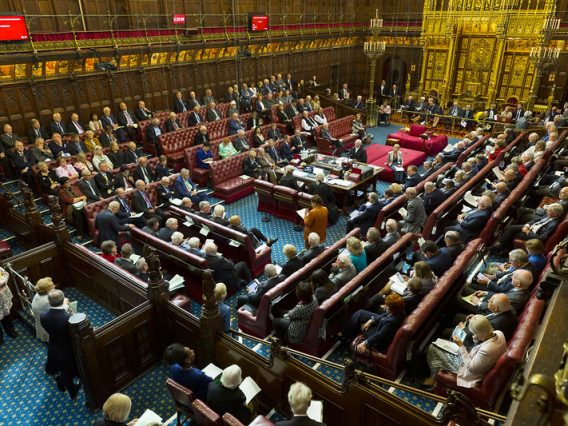
In 1996, separate financial assistance for opposition parties in the House of Lords was introduced. This became known as ‘Cranborne Money’ after Viscount Cranborne, the then Leader of the House of Lords. The original motion allowed that the largest opposition party in the House of Lords would receive £100,000 per financial year, and the second largest opposition party would receive £30,000. In 1999, official financial assistance was extended to the Convenor of the Crossbench Peers for the first time. This assistance was to be increased annually in line with the retail prices index. At various points, the sums have been increased above inflation, by resolution of the House.
In response to the fact that the Liberal Democrats were no longer in opposition following the general election in May 2010, the House agreed a motion to suspend the allocation of financial assistance to the second largest opposition party. This was reversed following the May 2015 general election.
Salaries for the Leader of the Opposition and the Opposition Chief Whip were first introduced in 1965, and these salaries are currently provided for under the Ministerial and Other Salaries Act 1975. The Ministerial and Other Salaries Act (1975) Amendment Order 2011 set these salaries at £68,710 and £63,537 respectively. Since 1997, these salaries have been increased annually in line with average increases in Senior Civil Service pay bands.
![House of Lords (Alternative Second Chamber) Bill [HL]: HL Bill 11 of 2026–27](https://lordslibrary-parliament.studio24.dev/content/uploads/sites/2/2020/09/House-of-Lords-568x426.png)