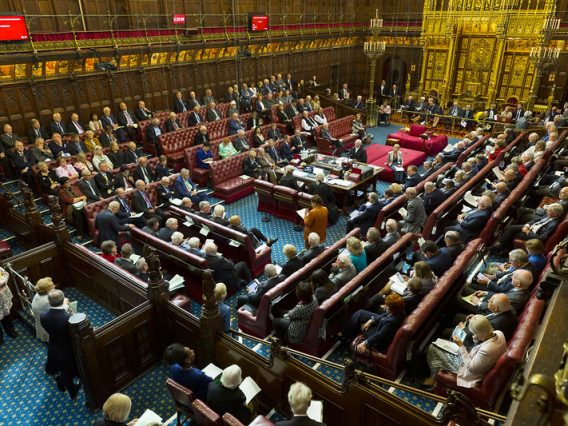
The relative size of the political parties in the House of Lords has been a subject of interest for many years. The implementation of the House of Lords Act 1999 removed the majority of hereditary peers from the House and represented a major change in its composition. The overall size of the House of Lords (as defined as those Members eligible to sit) has risen from 690, following reform in 1999–2000, to 807 at the end of the 2015–16 session. During this time no one party or group has held a majority. Nevertheless, the relative sizes of the parties and groups has changed over time with the appointments made to the House by successive Prime Ministers.
Membership data in the House of Lords is available since the 1984–85 session. As a percentage of the whole House, the Conservative Party has been the largest party group since the 2013–14 session (currently 30.6 percent). In contrast, the Labour Party currently constitutes 26.1 percent of the House, 4 percentage points lower than their peak of 30.1 percent in the 2008–09 session. The Liberal Democrats are currently at their highest percentage of the whole House since 1984–85, at 13.5 percent, whilst the Crossbenchers are at their lowest, at 21.7 percent. In terms of division participation, the average number of Members voting per division was 365 in the 2015–16 session. The Government was defeated in 53.1 percent of divisions in 2015–16, the highest percentage since 2004–05, and the second highest since 1984–85. This Lords Library briefing will be updated following the end of each parliamentary session.
An editorial change was made to this briefing on 3 June 2021.
![House of Lords (Alternative Second Chamber) Bill [HL]: HL Bill 11 of 2026–27](https://lordslibrary-parliament.studio24.dev/content/uploads/sites/2/2020/09/House-of-Lords-568x426.png)