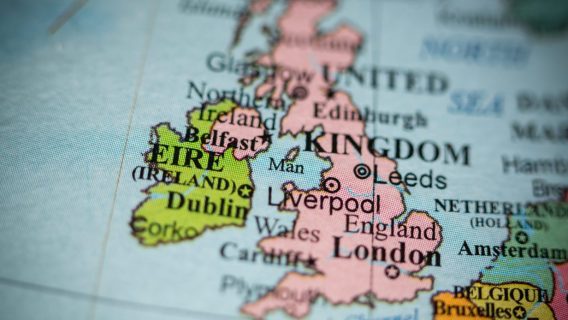
Belfast Agreement: Overview and Background
The Belfast Agreement, also known as the Good Friday Agreement, marked a landmark moment in the Northern Ireland peace process and paved the way for power-sharing in the Province. The accord, which concluded all-party negotiations that had begun in 1996, was formed of two parts. The first was a multi-party agreement reached between most major political parties active in Northern Ireland at the time—the exception being the Democratic Unionist Party (DUP) which was opposed to the Agreement. The second was an international agreement between the Governments of the United Kingdom and the Republic of Ireland. As a whole, it provided for a number of constitutional and institutional changes, including:
- the establishment of a 108-member Northern Ireland Assembly with a power-sharing executive;
- new cross-border institutions such as a North South Ministerial Council, and associated implementation bodies, bringing together those with executive authority in both Northern Ireland and the Republic of Ireland;
- a new British-Irish Council, bringing together the UK and Republic of Ireland Governments and representatives of devolved institutions from across the British Isles; and
- a new British-Irish Agreement, setting out a shared understanding between the UK and Republic of Ireland Governments on constitutional matters and creating a British-Irish Intergovernmental Conference.
As part of the accord, the UK Government undertook to respect the establishment of a united Ireland if that was to become the wish of a majority of people living in Northern Ireland. In turn, the Republic of Ireland agreed to amend articles in its constitution that extended a constitutional claim to the six counties that comprise Northern Ireland. The Agreement also included proposals on policing, the decommissioning of paramilitary weapons and the early release of paramilitary prisoners.
The Agreement was endorsed in referendums held in both Northern Ireland and the Republic of Ireland on 22 May 1998. In Northern Ireland, 676,966 people voted in favour of the accord (71.1 percent), while 274,879 voted against (28.9 percent). Turnout was 81.1 percent. In the Republic of Ireland, the margin of approval for the Agreement was higher: 1,442,583 people approved proposed amendments to the Irish constitution to implement the Agreement (94.4 percent), against 85,748 people who opposed the proposals (5.6 percent). However, this was on a lower turnout of 55.6 percent.
Elections to the new Northern Ireland Assembly were held on 25 June 1998. The Ulster Unionist Party (UUP) won the most seats (28), followed by the nationalist Social Democratic and Labour Party (SDLP) (which won 24 seats). In line with this result, UUP Leader David Trimble (now Lord Trimble) became First Minister in the new power-sharing executive, with the SDLP’s Seamus Mallon serving as Deputy First Minister. The devolved Assembly was active in shadow form until December 1998, when the Agreement came into force. Between the June election and the devolution of power in December, David Trimble and John Hume, then Leader of the SDLP, jointly received the Nobel Peace Prize “for their efforts to find a peaceful solution to the conflict in Northern Ireland”. Both individuals had played a significant role in the all-party negotiations that resulted in the Belfast Agreement.
Subsequent Developments
During its early years of existence, the Northern Ireland Assembly and its power-sharing executive was suspended in February 2000, August 2001 and again in September 2001 due to disagreements over issues such as parades, policing and decommissioning. In October 2002, following a fourth suspension of the Assembly, the UK Government re-established direct rule. This was to last until March 2007.
The political impasse that had led to the October 2002 suspension was resolved following multi-party talks held in St Andrews, Scotland, in October 2006. Unlike during the earlier Belfast Agreement negotiations, the largest unionist and nationalist parties on this occasion were the DUP and Sinn Féin, respectively. The St Andrews Agreement, which resulted from the talks, set out a path for the restoration of devolution. This followed agreement on issues that had stood in the way of an earlier return, including on policing and criminal justice system matters and in relation to modifying how institutions created by the Belfast Agreement operated. Devolution of police and justice matters followed the signing of a separate agreement reached at Hillsborough Castle in February 2010. A later accord reached in December 2014, the Stormont House Agreement, contained provisions relating to further issues such as finance and welfare reform; flags, identity and culture; parades; and the past. The Fresh Start Agreement, reached in November 2015, concerned implementation of the Stormont House Agreement and the impact of continued paramilitary activity.
There has not been an executive in place in Northern Ireland since the resignation of the late Martin McGuinness as Deputy First Minister in January 2017, following a breakdown in relations between the DUP and Sinn Féin—the two largest parties following each election held since 2003. This triggered an Assembly election in March 2017. The parties disagree on a number of issues that are yet to be resolved, including, but not limited to: use of the Irish language; dealing with the legacy of the Troubles; same-sex marriage; the potential mismanagement of a renewable heat incentive scheme; and the parties’ respective positions on Brexit. Multi-party talks, aimed at resolving the current impasse, are continuing.
![House of Lords (Alternative Second Chamber) Bill [HL]: HL Bill 11 of 2026–27](https://lordslibrary-parliament.studio24.dev/content/uploads/sites/2/2020/09/House-of-Lords-568x426.png)
![Youth Justice Board for England and Wales (Restoration of Powers and Responsibilities) Bill [HL]: HL Bill 20 of 2026–27](https://lordslibrary-parliament.studio24.dev/content/uploads/sites/2/2020/01/Government-VIGS-568x426.jpg)